Passing Ahead in Transition: How to Run a Fast Break That Actually Works
27 March 2026
The moment most teams waste
A rebound is secured. The defence is scrambling. For about two seconds, your team has a numbers advantage and the other team is in chaos.
Two seconds. That’s the whole window.
Most youth teams waste it. The ball-handler dribbles slowly up the floor, the defence recovers, and suddenly it’s a half-court set against five organised defenders. The advantage is gone. The moment has passed.
Good transition basketball is about recognising that moment — and acting before it disappears.
Phase 1: The outlet
It starts the instant the ball is secured. Not after two dribbles. Not after looking around. Immediately.
The rebounder outlets to a guard already moving to the outlet box — roughly 45 degrees from the basket, free throw line extended, on the sideline. This is the first pass of the break, and its only job is to get the ball to someone who can push it forward, fast.
The guard in the outlet box is not a destination. They’re a relay. They catch, and their first look is ahead — into the space the defence hasn’t filled yet.
The lanes: wide and early
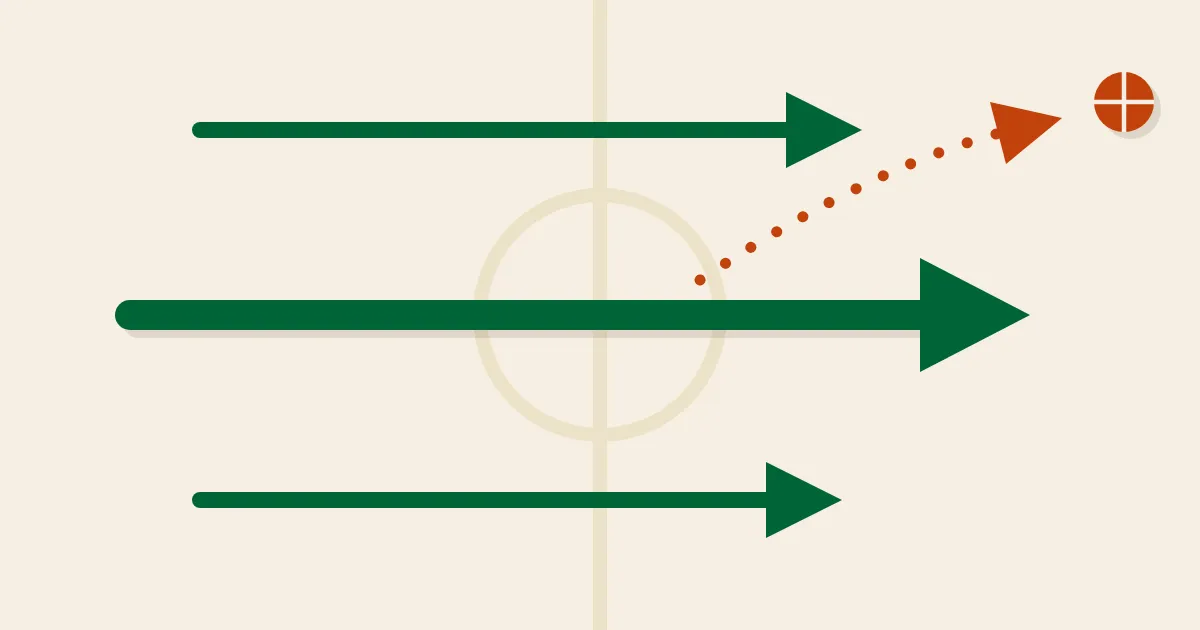
While the outlet is happening, the first two players off the rebound have one job: get wide and sprint.
Wide means within a metre of the sideline. Not drifting towards the middle — hugging the line. Because width does three things at once:
- Stretches the defence across the full width of the floor
- Opens the middle lane for the guard pushing the ball
- Creates passing angles a compressed defence can’t cover
The reference point for wide runners is simple: check your inside shoulder. The pass is coming from the middle of the floor. Running wide with your inside shoulder checked, you’re always in position to receive it.
And here’s the part that makes the whole system self-sustaining: reward the run. Every time a sprinting runner gets the ball, the habit deepens. Guards who don’t pass ahead train their teammates to stop sprinting. Guards who do pass ahead train their teammates to run harder every single time.
Recognising Phase 1
Before pushing into half court, the guard with the ball makes one read: is Phase 1 on?
Phase 1 is on if either of these exists:
- A clear lane to the basket — no defender between ball and rim
- A numbers advantage — more attackers than defenders in front of the ball
If yes: attack immediately. Don’t dribble to a spot. Don’t wait for the play to develop. Go.
The skill here is speed of recognition. Players need to read this in real time — not think it through, feel it. That’s what separates teams that convert fast breaks from teams that talk themselves out of them.
When Phase 1 isn’t on: Phase 2
Defence recovered? Numbers even? The break flows into Phase 2.
The ball-handler dribbles to their spot — the top of the key — and the trailing players become the weapons:
- Strong side cuts from players who followed the break from behind
- Lap post-ups — the trailing big sealing their defender on the block, using the momentum of the break to establish position before the defence is fully set
These actions exist because the break was run properly. The wide runners and the push have already dragged the defence towards the ball, and the trailer — arriving late but moving with purpose — walks into space that a lazy break never creates.
The good news: Phase 2 is highly coachable. Strong side cuts and lap post-ups can be drilled at any level, with any age group. The reads aren’t complicated. The habit just needs reps.
What to drill
Build it in sequence, across sessions:
- Outlet and push — rebounder to outlet box to guard, guard pushes the middle lane. Walk it, jog it, then full pace.
- 3-lane break — wide runners check the inside shoulder, guard reads who’s open. Run it until the spacing is automatic.
- Phase 1 read — add one retreating defender. Guard decides: lane clear? Go or hold?
- Phase 2 entry — add a trailer. Ball to the spot, trailer cuts or posts.
The recognition — is Phase 1 on? — only develops through repetition. You can’t teach it with diagrams. It has to be felt, read, and rewarded in real time.
The simple truth
Fast breaks aren’t complicated. They feel complicated because the decisions happen fast. But the decisions themselves are binary. Lane clear? Numbers advantage? Yes — go. No — Phase 2.
What makes transition basketball work isn’t athleticism. It’s recognition, spacing, and guards willing to pass ahead.
Pass ahead. Reward the runners. The rest follows.
Transition space is the biggest and cheapest space in the game — and the fastest to expire. Where it sits alongside the other four kinds is in The Five Kinds of Space.
More in fundamentals
Stay in the loop
New posts
by email.
Game breakdowns, session notes, and coaching ideas — when they're published, not on a schedule.
No spam. Unsubscribe any time.